
Scientists basically censor themselves
Guess who gets implicated for blame?
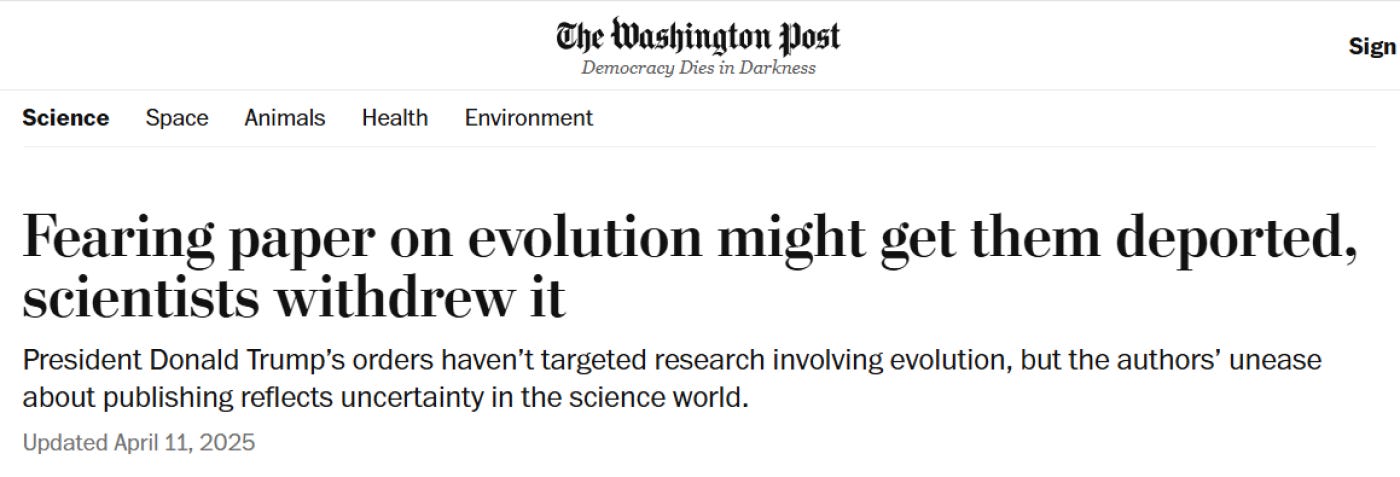
Trump’s anti-science regime is working so well, scientists are preemptively censoring themselves. The Washington Post is on it:
A few days before they were to submit a scientific paper together, an evolutionary biologist in Europe received an unexpected request from two co-authors in the United States.
After much thought, the co-authors said they preferred not to risk publishing at this time. One had just lost a job because of a canceled government grant; the other feared a similar fate if they went ahead with the paper. Although both were legally in the U.S., they worried they might lose their residency if their names appeared on a potentially controversial article.
Have grant terminations targeted studies on evolution? We’re told no, but the coauthors on a paper on evolution fear they might be deported for their “potentially controversial” article.
That sounds pretty bad. Like someone should look into that. Maybe they could go up the NIH chain and ask a straightforward question to remove the ambiguity.
The Post cites layoffs, reductions in funding, and scaling back the hiring of grad students as if it all fits into a dystopian narrative of deportations.
They describe this “incident” — which, to be clear, has nothing to do with this current administration punishing the authors for their research, but is still labeled an “incident” — as capturing the “chill hanging over science.”
Who is stopping your science?
We are.
It suggests a performativeness worthy of South Park.
And now Michael L. Wong, the astrobiologist who was supposed to edit the paper, laments he won’t even get to read it:
“I was so looking forward to reading this paper because I think the ideas in it are potentially transformative,” Wong said. “But the fact that people, scientific researchers, are afraid of just engaging in normal scientific discourse, putting their well thought out ideas into the public sphere so that everybody can see them, read them, come to their own conclusions about them and then debate them ― it is so disheartening.”
He really wanted to read the paper, mull over its well-thought-out and potentially “transformative” ideas — just to let us know the magnitude of what’s been fake-suppressed — but he can’t because the two scientists who are not the Trump administration decided it was “Too Hot to Publish.”
To be clear:
The researchers decided not to publish.
It’s the administration’s fault.
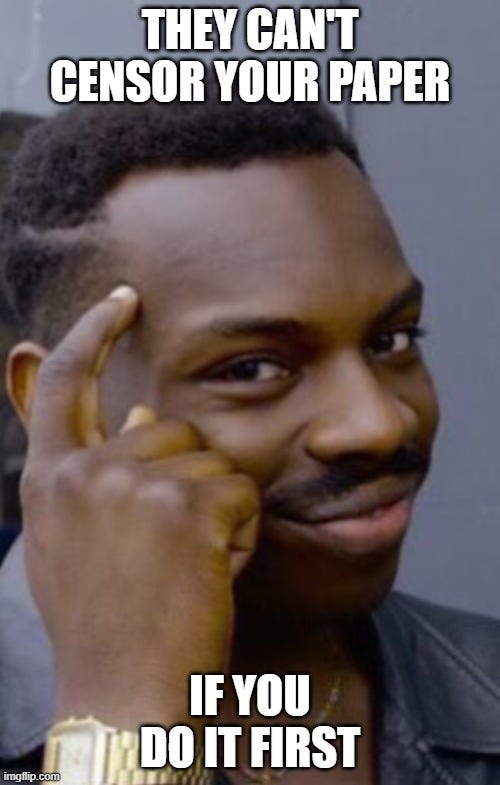
There’s a whiff of fainting-couch drama and “see what you made us do to our research, is this what you want??” to this.
As for the overall framing of the article, there’s zero pushback but an abundance of credulity or at least sympathy toward the “we have reason to be fearful” sentiments.
A journalist with at least 24 years of experience tees up a narrative for an audience eager to believe its premise of government threats to academic freedom, scientific research, and freedom of movement. What it doesn’t do is question or add context to illuminate or validate those threats to specific situations. (It’s not as if the resarach was still in a funding phase, in which case, the decision to fund or not could simply be about priorities, not disfavored knowledge. The research was done. The paper, apparently, written.)
Instead, we get direct-from-the-factory delivery of things to be alarmed by:
research deemed too dangerous to share
acceptable topics of research may be subject to “the whims of a select few individuals”
researchers with a layover in the U.S. on their way to Belize might be deported
You’d expect a serious journalistic enterprise that cares about context and understanding — you know, being genuinely curious — to bring this back to basics:
is it reasonable to be this fearful?
Offer some specific evidence for that fear.
Who in the administration is going to even notice this paper?
What does your research say that you think it would lead to your deportations?
Is there another, overriding reason for abandoning the paper, with “fear of deportation” some significantly downstream concern that happens to play well in this politically charged environment?
That’s the thing about reporting: Sometimes you can get closer to the clear-eyed understanding of a situation, if not the truth.
Yale prof Jason Stanley earned Resistance-gilded fanfare and media attention for his recently announced decision to leave the United States for Canada. Because Trump, of course.
Except this exchange on the PBS News Hour changes the texture of that announcement a bit, doesn’t it? Bold in Stanley’s answer is mine:
Amna Nawaz:
We have seen universities come under attack of this administration. Is this just — your decision, is it just about what you have seen happening at universities and colleges?
Jason Stanley:
Well, that was what sealed it.
I had an offer from the University of Toronto and had gone back and forth about the offer. I had thought — I'd assigned like 50 percent probability to taking it. But when Columbia folded, that's when I thought, OK, I'm just going to look at the probabilities of our institutions folding, of our democratic institutions folding. And by that, I mean not just the universities, but the media and our legal system.
And I thought, well, maybe they can hold the line, but this is an opportunity. It's a great opportunity. And I think the probabilities are not in the favor of U.S. democracy.
If it turns out the unnamed authors of the paper are genuinely concerned about being deported, and that’s the only reason they’re not publishing, then how about this:
Publish and find out.
This is how you prove the anti-science, fascist nature of the administration, sunlight as the best disinfectant and all that. Let’s get it right out in the open.
That’s a story just about every notable media outlet would seize on. The scientists would be heroes and their praises sung across news segments, talk shows, editorials. Trump and his administration would have to explain why they’re suppressing research into evolution, which would play into an anti-progress, anti-human narrative of religious narrow-mindedness and general ass-backwardness.
I’m sympathetic to concerns about career paths and opportunities, along with the big-picture worry about the course of scientific discovery. It feels like there’s hasn’t been anything approaching tact when it comes to hitting the brakes on a funding enterprise that has probably been taken for granted.
But amidst genuine confusion, it’s the indulgence in the ambiguity, the state of not-knowing that drives this narrative of fear. And that’s a story that, in its odd way, is comforting to the Resistance Left. This story of preemptive censorship confirms for them that distress, worry and retreat are valid, logical responses to something nefarious that Trump and his administration could do.
Is it true in this particular circumstance? By not asking but entertaining, the possible threat has power that must be defied and galvanizes a movement of morally informed resistance that feels good as it elides the details.